
The economic impacts of the COVID-19 pandemic influenced the integration outcomes of – both and in Canada. In general, these groups are more negatively affected by the COVID-19 crisis than those born in Canada, and these disparities create additional barriers to the integration process. Tracking the impact of the COVID-19 pandemic on immigrants relative to the Canadian-born population with empirical evidence and incorporating this into the CIMII is especially critical. In order to explore this, two analyses have been conducted.
Quebec
Data below is based on the monthly Labour Force Surveys collected from January 2019 to December 2020.
Below you will find 1) CIMII Ranking/ Adjusted Data and 2) Unadjusted Data.
CIMII RANKINGS
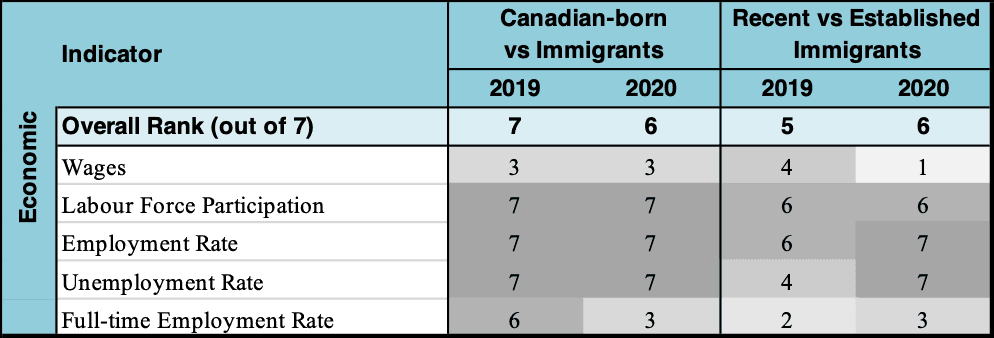
Quebec ranks #7 out of the 7 regions for immigrant economic integration in 2019 and #6 in 2020. It ranks a bit better when the gap between recent and established immigrants is compared (#5 in 2019 and #6 in 2020).
Quebec performs poorly on most economic indicators in 2019 and 2020, including labour force participation, employment, and unemployment rate, but performs average on wages. When the gap between recent and established immigrants is analyzed, Quebec performs poorly in almost all indicators, except wages.

UNADJUSTED DATA
See below for the breakdown of immigrants, recent and established, and the Canadian-born population in this region. Any blank in the chart indicates that the data is unavailable/statistically insignificant. Please note that the data below does not control for socio-demographic characteristics, unlike our rankings above.
Median weekly wages (full time)
Median weekly wages (full time) Without accounting for socio-demographic differences, full-time immigrant workers consistently earned less than their Canadian-born counterparts prior to and during the pandemic, with the gap varying from $33 to $119 in most survey months. The only exception was in March 2019, when established immigrants earned more than non-immigrants.
Note: All wages seen here are before Consumer Price Index (CPI) adjustment
Median weekly wages (part time)
Without accounting for socio-demographic differences, the wage gap between part-time immigrant workers and their Canadian-born counterparts varied prior to and during the pandemic, but it was less than $55. Recent immigrants were the group that had the lowest wage in most survey months, except in March 2019, when they had the highest wage. While the average gap between recent and established immigrants was $32, the largest was in January 2020, $113.
Note: All wages seen here are before Consumer Price Index (CPI) adjustment
Labour force participation
Without accounting for socio-demographic differences, the gap between immigrants and the Canadian-born population varied before and during the pandemic, although it stayed relatively small (less than 3%). The gap was much bigger between recent and established immigrants, the highest was in January 2019 (13%). There was a 4% drop in labour force participation in 2020 between February and April for all groups.
Employment rate
Without accounting for socio-demographic differences, established immigrants were more likely to be employed than recent immigrants during these two years. The most significant gap was in April 2020, 14%. The gap between Canadian-born population and immigrants varied, but it stayed relatively small (less than 4%). A significant shift in the employment rate was seen from February to April 2020, when it went down by more than 13 percentage points (the largest was for recent immigrants 15.3%).
Unemployment rate
Without accounting for socio-demographic differences, recent immigrants were consistently more likely to be unemployed than established immigrants over the survey months. The only exception was in April 2019, when established immigrants had a higher unemployment rate. The unemployment rate varied for all groups, but it went sharply up at the onset of the pandemic in April 2020. After this point, the unemployment rate had a downward trend for all groups, except for recent immigrants; for them, the unemployment rate went up again in July 2020.
Full-time employment rate
Without accounting for socio-demographic differences, immigrants in most survey months prior to and during the pandemic were more likely to work full-time than their Canadian-born counterparts; the gap varied but it never went over 2%. The gap between recent and established immigrants was bigger across all survey periods, the highest was in January 2020 (5%).